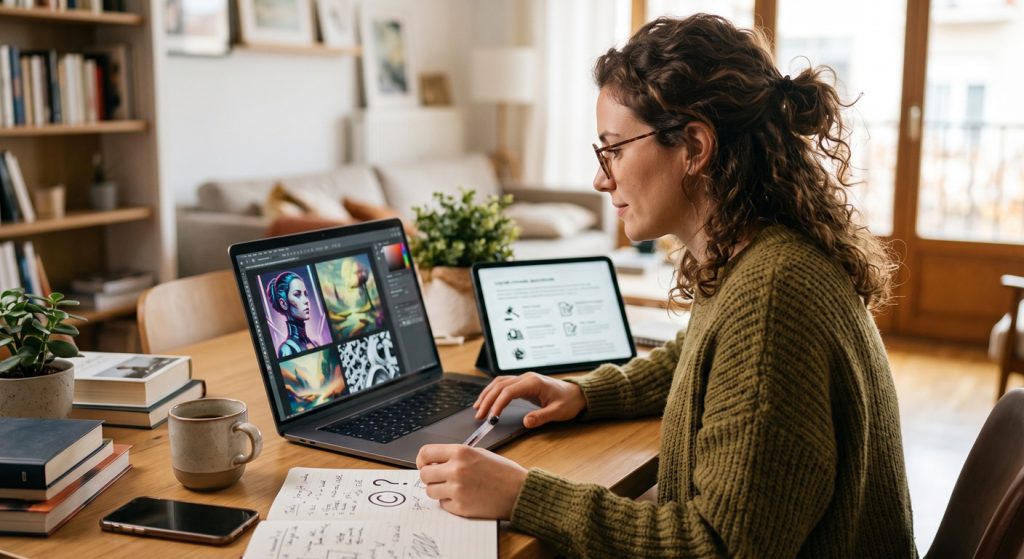
AI generated images have quietly become the default source of blog visuals, and most people using them have not checked what they are getting. The picture at the top of a post is cheap, fast, and matched to the topic. Whether anyone owns it is a separate question, and the answer is probably not what the person who typed the prompt assumes.
This covers the ownership rules as they stand in the US, where these tools fit real publishing work, and the mistakes that turn a free image into a problem.
Who owns AI generated images
The US Copyright Office settled its position in January 2025, in the second part of its report on copyright and artificial intelligence. Copyright protects human authorship. An output generated from a text prompt does not qualify, because prompts influence a result without determining its expressive elements. Typing a long, detailed prompt does not change that. Typing a hundred of them does not either.
Protection returns when a human contributes expression that survives into the final work. Feeding in your own drawing or photograph and having the model build on it can be protected, since your original input is perceptible in the output. So can creative arrangement or modification of generated material, which is how an illustrated article or a composite graphic stays copyrightable even when parts came from a model. Using AI somewhere in the process does not disqualify the larger work.
For a blog, the practical consequence is narrow and worth knowing: a featured image produced from a prompt is likely in nobody’s exclusive control. A competitor can lift it and use it, and there is no infringement claim to make. Anything that needs to stay yours, a logo or a signature brand asset, should not come straight out of a generator.
Commercial use is a separate question from ownership
These two get confused constantly. Ownership is copyright law. Commercial use is the platform’s terms of service, which is contract, and the terms decide what a subscription permits.
The distinction shows up in pricing. On Recraft, the free tier generates public images for personal use, while paid plans start around $10 a month and add commercial rights plus private generation. That pattern is standard across the category, and it means a free account is usually the wrong tool for anything published on a monetized site. Check the current terms before relying on any of this, since generators revise them often.
Recraft is worth a look for a specific reason rather than as a general recommendation: it produces true vector output, so icons, logos, and illustrations come out as editable SVG files that scale cleanly, which most generators cannot do. For blog work that means reusable brand assets instead of a fixed-resolution PNG. The company has raised around $42 million and reports more than four million users, so it is established without being the market leader. Midjourney, Adobe Firefly, Ideogram, and Canva cover the same ground with different trade-offs.
Where the tools earn their place in publishing
Featured images are the obvious use and the least interesting. The gains come from visuals nobody would commission: a diagram for a process described in a post, an icon set that makes a comparison table readable, a custom illustration for a concept that stock photography answers with a handshake and a laptop.
Consistency is the underrated benefit. A blog that has run on random stock images for years looks assembled by committee. Generating visuals from one defined style, applied across every post, does more for how a site reads than any single image does.
The honest limits apply too. Models still fumble text inside images, hands, reflections, and anything requiring a specific real object to look exactly right. Vector output often carries more anchor points than a designer would use, so files need cleanup before anything precise. And the aesthetic is now recognizable, which means a visibly generated image can register as filler rather than effort.
The mistakes that cause actual problems
Prompting in the style of a named living artist is the first. It may not be infringement by itself, but it creates a reputational exposure no blog needs, and several platforms restrict it.
Trademarks and real people are the second. A generated image containing a recognizable logo, product design, or identifiable person carries the same risk it would if drawn by hand. Copyright is not the only law in the room. The same disclosure logic that now surrounds AI voice cloning is spreading to visual media, and platform labeling rules keep tightening.
Registration is the third, and it catches people who publish books or courses off the back of a blog. The Copyright Office’s registration guidance, effective since March 2023, requires applicants to disclose AI-generated content in a work and disclaim material that is more than trivial. Failing to disclose can invalidate a registration, which is worse than never registering.
A working checklist
- Use a paid tier for anything on a commercial site, and read the current terms rather than a review of them
- Keep a record of which images were generated and with what tool, for later registration or licensing questions
- Do not generate logos or signature brand assets, since you cannot own the result
- Avoid prompting in the style of named living artists
- Check outputs for trademarks, recognizable faces, and text artifacts before publishing
- Define one visual style and apply it across the site rather than generating each image fresh
- Add descriptive alt text written by a person, because generators do not produce it and search engines still read it
FAQ
Can AI generated images be copyrighted?
Not on their own. The Copyright Office holds that prompts alone do not create human authorship, so a purely generated image is unprotected. A work that includes generated material alongside human expression can be protected, covering the human contribution and any creative arrangement or modification, but not the generated parts themselves.
Is it legal to use AI generated images on a blog?
Generally yes, subject to the platform’s terms. Most generators grant commercial use on paid plans and restrict it on free ones. Separate risks come from what the image contains rather than how it was made, which is why trademarks, product designs, and recognizable people need checking.
Do AI generated images need to be disclosed?
For copyright registration, yes: applications must disclose AI-generated material and disclaim anything beyond trivial. For ordinary blog publishing there is no general US requirement, though platform rules on synthetic media are expanding and EU transparency obligations now apply to some AI content aimed at European audiences.
Are AI generated images bad for SEO?
Not directly. Search engines judge pages on usefulness rather than how images were produced. The indirect cost is real though, since visuals that look generic reduce the time people spend on a page, and that behaviour does eventually show up in performance.